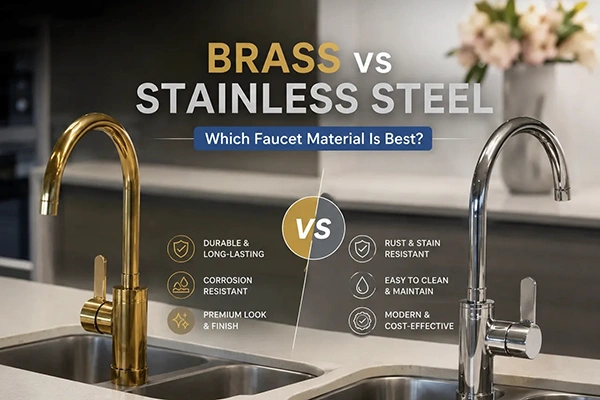
The material of a faucet body directly affects its durability, corrosion resistance, weight, manufacturing process, and cost. Brass has traditionally been one of the most common materials for faucets, while stainless steel is gaining attention as an alternative, especially as manufacturers face increasing cost pressure and demand for durable, long-lasting products.

1. Stainless Steel vs. Brass: Key Differences
Stainless steel is an iron-based alloy containing chromium. 304 stainless steel, for example, typically contains about 18% chromium and 8% nickel. Brass is primarily a copper-zinc alloy, commonly containing around 60–70% copper.
| Property | 304 Stainless Steel | Typical Brass |
|---|---|---|
| Main Composition | Iron + Chromium + Nickel | Copper + Zinc |
| Density | ~8.0 g/cm³ | ~8.4–8.7 g/cm³ |
| Melting Range | ~1,400–1,450°C | ~900–940°C |
| Corrosion Resistance | Excellent | Good |
| Strength | High | Moderate–High |
| Machinability | Moderate | Excellent |
2. Corrosion Resistance
Stainless steel’s chromium content creates a passive protective layer on the surface, providing excellent resistance to corrosion. This is particularly useful for bathroom environments exposed to water, humidity, cleaning products, and frequent use.
Brass also provides good corrosion resistance and has a long history of use in plumbing products. However, its performance depends on the specific alloy and environment.
3.Strength and Weight
304 stainless steel has a density of approximately 8.0 g/cm³, compared with 8.4–8.7 g/cm³ for typical brass. For the same volume, stainless steel can therefore be approximately 5–8% lighter.
Stainless steel also generally offers higher strength and hardness, while brass provides good toughness and is easier to process.
4. Manufacturing and Cost
Brass has an important manufacturing advantage: excellent machinability. It can be efficiently cut, drilled, threaded, cast, and formed, making it suitable for complex faucet components.
Stainless steel is harder to machine and requires appropriate tooling and production processes. However, advances in stainless steel casting, CNC machining, and forming technologies have made it increasingly practical for faucet manufacturing.
Material prices fluctuate, but brass contains a high percentage of copper, meaning its raw material cost is strongly influenced by copper prices. Stainless steel provides manufacturers with another material option when managing material costs and long-term product value.
5. Which Material Is Better?
Neither material is universally better. Stainless steel offers high strength, excellent corrosion resistance, and a modern material solution, while brass offers excellent machinability and mature manufacturing technology.
For faucet manufacturers, distributors, and project buyers, the best choice depends on the alloy grade, product design, manufacturing process, required performance, and target cost.


